
Laser Fault Injection: Unmatched Precision for Physical Security Evaluation

As hardware attacks become increasingly sophisticated, security evaluation methods must evolve to keep pace. Among the most advanced techniques available today, Laser Fault Injection (LFI) stands out as a powerful and precise approach for assessing the robustness of electronic components.
What is Laser Fault Injection?
Laser Fault Injection (LFI) is a cybersecurity attack technique that disrupts the operation of a microchip by directing short, highly precise laser pulses at targeted areas of the silicon.
This method enables controlled fault injection at the bit level, allowing engineers to analyze how a device behaves under intentional perturbations.
A typical LFI setup includes:
- A high-precision microscope
- A motorized positioning platform
- A controllable laser source
Two main approaches are commonly used:
- Front-side injection: visible access to the chip surface
- Back-side injection: infra-red access through the silicon substrate.
With fine control over timing, spatial, and energy amplitude, LFI delivers highly repeatable and targeted testing capabilities.
Access the Product Documentation
Superior Precision Compared to Other Techniques
Compared to techniques such as Electro-Magnetic Fault Injection (EMFI), LFI provides significantly higher spatial resolution—down to 1 micrometer.
This level of precision makes it possible to target:
- Specific logic cells
- Individual transistors
- Even single-bit fault injections
LFI is particularly effective for analyzing:
- Cryptographic implementations (AES, PKC, PQC)
- Security countermeasures against faults
A Key Enabler for Certification
Within certification frameworks such as Common Criteria (CC), Laser Fault Injection is recognized as a high-end attack method suitable for the highest assurance levels (EAL5+ to EAL7).
Its precision enables evaluators to demonstrate the real robustness of a device against targeted attacks—an essential requirement for:
- Secure components
- Payment applications (EMVCo)
- Automotive systems
- Critical infrastructures
An Innovative Laser Station for Security Labs
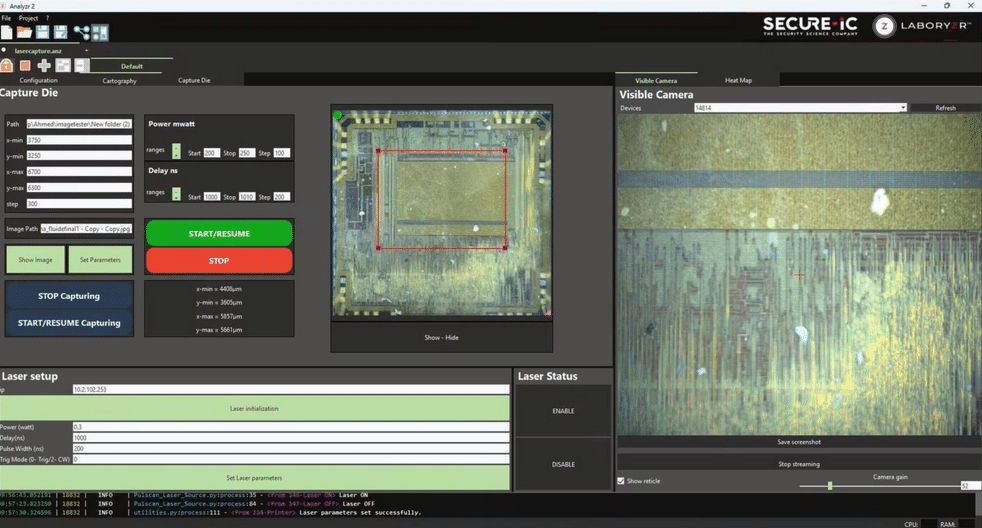
Secure-IC introduces an advanced Laser Station designed to push the boundaries of fault injection testing. Fully integrated into the Analyzr™ Fault Injection software environment, it streamlines test campaigns and enhances analysis efficiency.
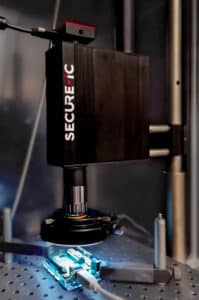
Key Features
- Up to three connected laser sources on a single platform for maximum flexibility
- Flexible and customizable architecture, supporting front-side and back-side operations, as well as single- or multi-mode configurations
- New optical system optimized for seamless laser alignment and highly repeatable performance
- Intuitive control interface through Analyzr™, enabling easy system management
- Compatibility with Laboryzr™ AI-based cartography, for advanced mapping and automation
- Ready for certification or evaluation, depending on project requirements
Tangible Benefits for Security Teams
Using a Laser Station enables teams to:
- Evaluate the robustness of secure elements, and cryptographic IPs
- Test resistance to fault attacks (e.g., DFA on AES, RSA-Bellcore, ECC scalar multiplication)
- Identify and bypass security mechanisms such as authentication, redundancy, fault sensors
- Enhance the capabilities of security labs for advanced hardware testing
- Meet the requirements of high-level certification schemes
Access the Product Documentation
Whether you are working on evaluation, certification, or strengthening your security product, our experts are here to help